River & Water Safety

Where there's water, there's risk. The importance of safety in and around water is critical.

Whether you're visiting a pool, spending the day at the lake, floating the South Saskatchewan River or supervising children around water, a little preparation can save lives. Here you'll find safety tips, resources, and programs to help you enjoy the water safely this summer.

Tips to keep everyone safe around water

No single measure is enough on its own. Significantly reduce risks by combining the following safety measures:

Active supervision

  • Stay within arm's reach of young children
  • Phones down, eyes on
  • Designate a sober water watcher
  • Ensure layers of protection are in place for backyard pools (gates/locks are in place and locked at all times when active supervision is absent) 

Build water confidence

Plan ahead

  • Check weather and river conditions
  • Tell someone where you're going and don't go alone
  • Stay sober - alcohol and water don’t mix
  • For natural bodies of water like the river, know your exit before you enter

Wear a lifejacket

Lifejackets should be worn by anyone entering any body of water without strong swimming skills.

If you're using any recreational watercraft - including boats, kayaks, canoes, paddleboards, tubes, or paddle boats - you must wear a properly fitted, Transport Canada-approved lifejacket or PFD at all times on the following bodies of water:

  • The South Saskatchewan River and its creeks
  • Echo Dale Regional Park boating lake
  • Heritage Pavilion pond at Strathcona Island Park
  • Reservoir adjacent to College Drive SE.
  • Irrigation pond in South Ridge Community Park
  • Pond in Leinweber Park

Your lifejacket must be securely fastened, in good condition, and worn throughout your time on the water.

In accordance with bylaw 4859, lifejacket use is mandatory when using watercraft on any approved body of water within the City. Lifejacket use is also mandatory on the river; you could face a court appearance and up to $500 fine for not wearing a properly fitted and approved lifejacket or PFD.

  • Check that it is Transport Canada approved.
  • Check that it has the appropriate weight range and chest size. 
  • Start with the buckles and straps loose then fasten them from the bottom of the lifejacket to the top to ensure a snug fit. 
  • Once fastened, test the life jacket or PFD by holding your arms over your head and asking someone nearby to grab the tops of the arm openings and gently pull. Make sure the lifejacket does not slip over the chin and ears. If there are more than 3 inches between the shoulders and the lifejacket, it is too big.

Download a printable version from the Lifesaving Society.  

Planning a day on the river

Checklist for a safe experience

Ensure all of the following are in place before heading out on the water:

  • Check weather and river conditions
  • Ensure your watercraft is appropriate for river use and meets the weight capacity of your group
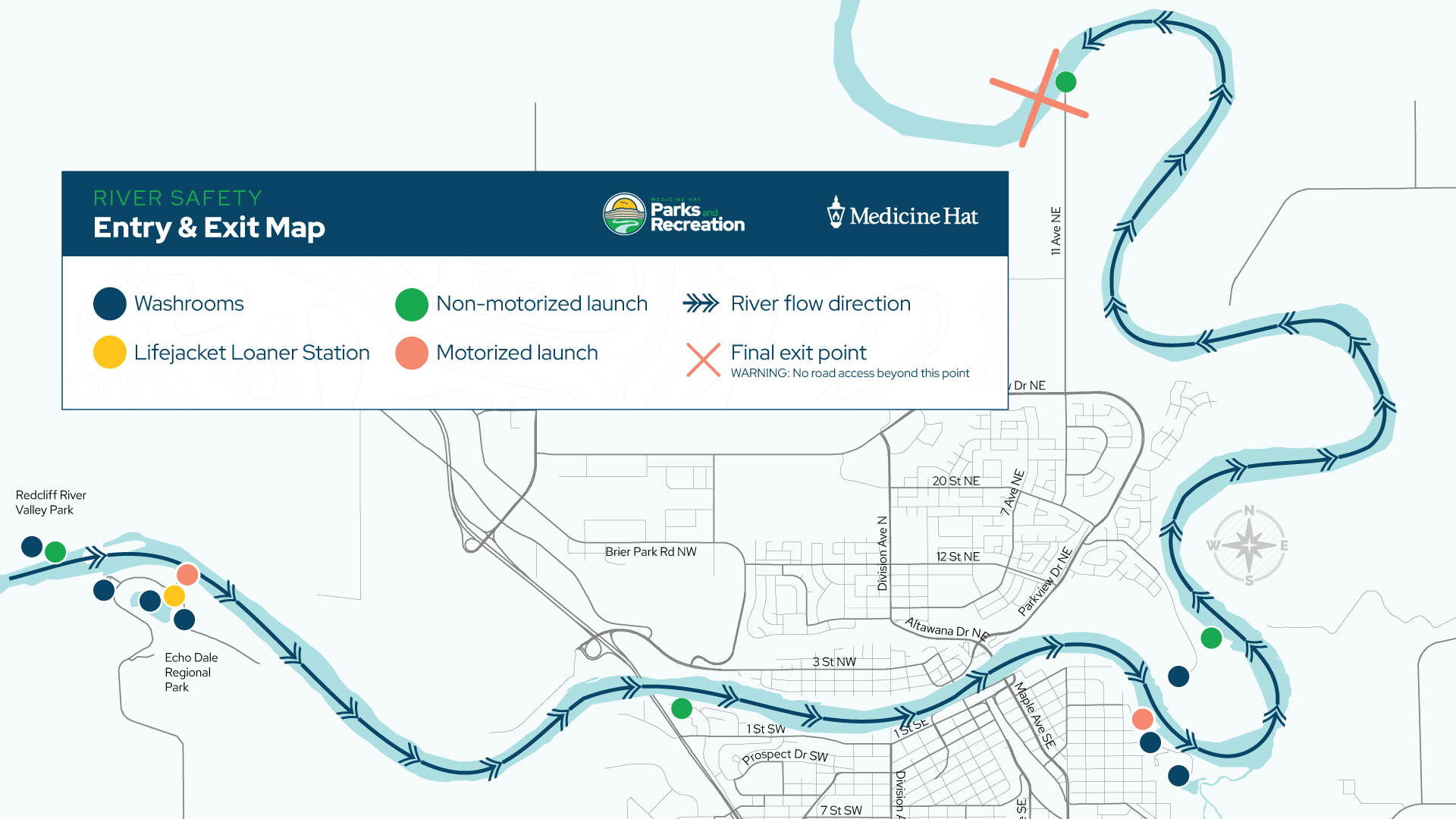
  • Plan your route and know where you'll enter/exit 
  • Share your plan with a friend/loved one
  • Pack a water safety kit in your watercraft
  • Ensure all participants are wearing a properly fitted lifejacket or PFD
  • Bring a friend; you're safer together
  • Bring a cell phone in case of emergency
  • Pack sunscreen, hats, snacks, and water/refreshments (stay sober; intoxication on water is unsafe and prohibited)


Checking the conditions

It's important to plan ahead and check weather conditions before heading out for a day on the water. If you're planning to enter the river, check river conditions before you go. Warm weather doesn't mean safe water; undercurrents can pull even strong swimmers under. 

Always SCOUT, ASSESS and DECIDE from shore before going on rivers, lakes and waterways.

  1. SCOUT the river for current and possible potential hazards.
  2. ASSESS the level of danger.
  3. DECIDE if it is safe to raft or boat.

Planning your route

There are specific spots along the river that are designated entry and exit points depending on the type of watercraft you're using. Know the route you're planning to travel and which of these points is your desired destination before setting out.

River Safety - Entry and Exit Points Map

  • Know where you are going and what obstacles or water features are on your route. This includes bridges, underwater hazards, shallow spots, trees, rocks, and wind.
  • Give yourself plenty of time to navigate around bridge piers. Tying rafts together will make it hard to steer and could result in rafts getting caught or stuck.
  • Be ready to exit the water before you reach your destination.
  • Remember to tell someone responsible where you are going and when you expect to return.
  • Call 911 in an emergency.


Building your safety kit

Safety kits are required on all types of watercraft including kayaks, canoes, dinghies, inner tubes and rafts. They need to include: 

  • A bailing device to remove water from inside the watercraft
  • A paddle or oar to help you control your craft
  • A sound-signaling device to help with navigation, alerting others of your approach, or in case of emergency (this could be a portable air horn, whistle, mechanical whistle or bell)
  • A heaving rope or towing line (15 meters long) that floats to use for rescue or to pull your craft to safety
  • Navigation or safety light to be used at night or in poor visibility

Small Vessel Regulations


Understanding river flow rates

While the river can be hazardous at any flow rate, recreational floaters prefer a flow rate between 100 m³/s and 400 m³/s. Download the Alberta River Basins app for easy access to flow rates on the South Saskatchewan River or check their website. As the river flows increase the water levels rise, and the water moves faster. River flows are evaluated by year-round, especially from May to August during flood season.

Stay up to date.

Subscribe to eNotifications to stay connected with City of Medicine Hat news, activities, events, programs, operations and more.