
Budget Process
Every two years, the City brings forward a budget that defines the funds required to run City programs and services, maintain and upgrade existing infrastructure, and invest in new opportunities.
Our budget is designed to meet the needs of the community while ensuring our finances stay strong over the long term.
Creating the budget

Planning
Administration uses Council’s strategic plan and input from Hatters to guide our planning.

Development
We create the budgets needed to deliver services.

Debate & approvals
These plans are brought to Council for deliberation and approval. Council considers public feedback in their decision.

Budget update
Each year, we update the budget to account for unforeseen changes through the budget cycle.
Council is required under the Municipal Government Act to approve the City’s operating and capital budget before December 31.
How is our budget built?
The City of Medicine Hat's budget is divided into four distinct areas.
Municipal*
This segment uses property tax revenue to provide traditional municipal services (parks, transit, protective services, recreation, roads, airport, planning, customer service, community supports, economic development, and more).
Land Development & Real Estate
This segment includes the City’s land inventory, the costs associated with holding land and property, and the revenues from leasing and selling land and property.
Rate-based Utilities
This segment of the budget includes water, sewer, solid waste, electric distribution and gas distribution and is funded through the utility rates and fees that are charged to customers that use these services.
Energy Production
This segment covers the City of Medicine Hat’s commodity-based energy production business including electric generation and gas production. It is funded through commodity charges to utility ratepayers, as well as revenue from selling excess electricity to the provincial grid.
|
|
|
|
Within each segment, funds are separated into an operating budget and a capital budget. Here’s how they differ:
Operating Budget
- Funds daily operations
- Short-term focus
- Salaries, utilities, fuel, supplies, software
- Expensed immediately
- Recurs annually
- Examples:
- Employee salaries and benefits
- Utilities for municipal buildings
- Snow clearing and road maintenance
- Parks maintenance and mowing
- Transit operations
- Fire and emergency services
- Fuel and vehicle maintenance
- Insurance and software subscriptions
- Contracted services
Capital Budget
- Funds long-term assets
- Long-term focus
- Buildings, equipment, infrastructure
- Capitalized and depreciated
- Project-specific or multi-year
- Examples:
- Building a new fire hall
- Reconstructing a road
- Replacing a water treatment plant
- Purchasing a new transit bus
- Constructing a new recreation centre
- Upgrading a stormwater system
Think of it this way:
- Operating Budget = Keeping the lights on
- Capital Budget = Buying or building the lights
The Capital budget is diced even further to account for sustaining capital (maintaining, upgrading or replacing what we already have) and strategic capital which is investment that expands capacity, service levels, or revenue potential.
Sustaining Capital
- Maintains existing assets
- Preserves current service levels
- Replaces worn-out infrastructure
- Often unavoidable
- Focused on reliability and risk
- Examples:
- Repaving an existing road
- Replacing aging water mains
- Replacing an end-of-life fire engine
- Replacing the roof on City Hall
- Upgrading an aging lift station
- Replacing HVAC systems in municipal facilities
Strategic Capital
- Expands assets or capacity
- Creates new service levels
- Adds new infrastructure
- Often strategic and discretionary
- Focused on growth and opportunity
- Examples:
- Building roads for a new subdivision
- Expanding a recreation centre
- Installing new water and wastewater infrastructure to support development
- Building a new park
Within the capital budget:
- Sustaining Capital = Replacing old lights when they wear out
- Strategic Capital = Adding lights to a new area
Each financial segment is funded differently
Municipal
Municipal revenue comes from:
- Property taxes
- Facility admissions and user fees
- Business licenses
- Building permits
- Grants
- Dividends from Business Units
- Endowment (Reserves) Dividend ($5M per year)
- Investment Income
We collect no more or less than what has been budgeted and approved by Council, reporting deficits or surpluses in the tri-annual report.
Land Development & Real Estate
The City sells surplus land.
Rate-based Utilities
Utility rates and fees cover the cost of providing the service plus a rate of return for maintaining, upgrading, or replacing infrastructure.
Energy Production
Energy Production is funded through electricity and natural gas commodity charges to utility ratepayers, as well as revenue from selling excess electricity to the provincial grid.
How money flows
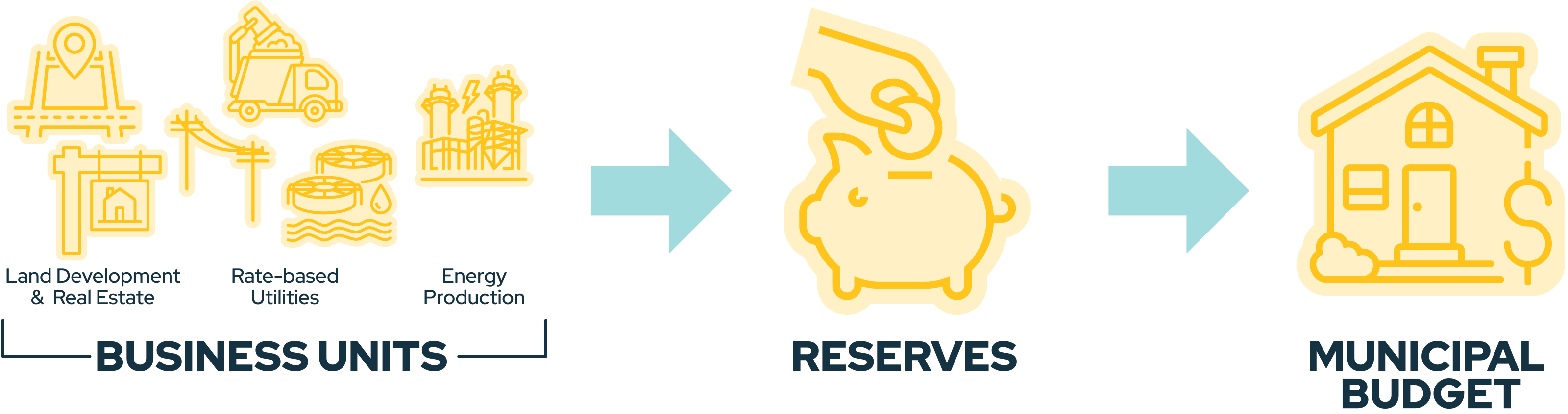
The Distributable Funds/Dividend Policy #0169 establishes the relationship between the City and its for-profit business units.
Our earning areas - utilities, land, and energy - generate funds that flow into reserves, which sit at the center of the City’s financial model. Free cash flow is the name we use for the funds flowing into the reserve from business units.
Stay up to date.
Subscribe to eNotifications to stay connected with City of Medicine Hat news, activities, events, programs, operations and more.


